

Global payment declines remain one of the biggest challenges for businesses operating internationally. Although some transactions are rejected for legitimate security reasons, many genuine payments fail because of issuer policies, cross-border processing complexity, or authentication issues. By understanding the causes of these declines and adopting the right payment strategy, businesses can improve payment approval rates, recover lost revenue, and provide a more seamless checkout experience.
What are global payment declines?
A global payment decline occurs when an international transaction is rejected before payment authorisation is completed. Depending on the payment flow, the decline may originate from the issuing bank, the acquiring bank, the card network, or an automated fraud detection system. Unlike domestic payments, cross-border transactions are evaluated against additional risk factors, making them more likely to be declined during the authorisation process.
Not every global payment decline transaction indicates fraudulent activity or insufficient funds. In many cases, legitimate payments are mistakenly blocked because they appear unusual compared to a customer's previous purchasing behaviour. These false declines have become a growing challenge for international businesses, as they prevent genuine customers from completing purchases despite having valid payment credentials.
For merchants, false declines can be particularly difficult to identify because customers often receive only a generic error message without knowing why their payment failed. As a result, many simply abandon the checkout process instead of attempting another payment method or contacting their bank. Reducing these unnecessary declines has therefore become an important objective for businesses seeking to improve payment performance across international markets.
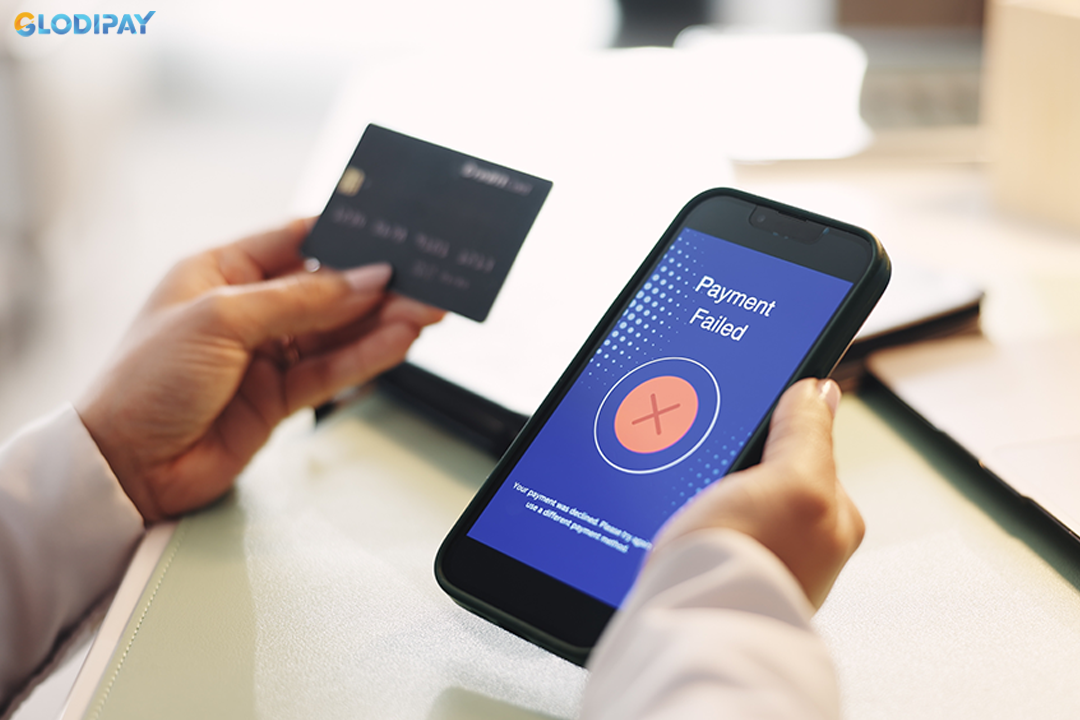
Global payment declines occur during international payment authorisation
Common causes of global payment declines
Although every declined transaction may appear similar from a customer's perspective, the underlying causes can vary significantly depending on the payment environment.
Issuer risk assessment and false declines
The issuing bank determines whether to approve or decline a transaction based on its internal risk assessment, evaluating factors such as transaction value, merchant category, location, and spending history. While these measures help prevent fraud, they can also lead to false declines when legitimate cross-border transactions are flagged as suspicious. For example, when customers make purchases from overseas merchants or while travelling. Reducing these unnecessary declines is essential for businesses looking to improve payment performance and customer satisfaction.
Cross-border payment complexity
Cross-border payments are more complex than domestic transactions because they involve multiple currencies, regional regulations, acquiring banks, and compliance requirements, all of which can affect payment authorisation. In addition, customer payment preferences vary across markets, making it important for businesses to support local currencies and preferred payment methods. Delivering a localised payment experience helps reduce payment friction, improve authorisation rates, and increase successful cross-border transactions.
Authentication and technical issues
Authentication and technical issues can also contribute to global payment declines. Security measures such as 3D Secure help prevent fraud but may create friction if customers cannot complete the verification process. In addition, technical problems - including network interruptions, expired card details, API integration errors, or communication failures between payment providers and financial institutions - can prevent legitimate transactions from being authorised. Maintaining a reliable payment infrastructure is therefore essential to improving payment performance.
Best practices to reduce global payment declines
While payment declines cannot be eliminated, many unnecessary failures can be prevented with the right payment strategy. These improvements will create a smoother purchasing experience for customers across different markets.
Optimise payment routing and local acquiring
The route a transaction takes can significantly influence whether it is approved. When payments are processed through acquiring banks that have stronger relationships with local issuers, authorisation rates are generally higher than when transactions are routed internationally. This is because local acquirers are more familiar with regional payment networks, regulatory requirements, and customer spending patterns.
Modern payment providers use intelligent routing to determine the most effective processing path based on factors such as the customer's location, card type and historical authorisation data. Instead of sending every payment through a single acquiring bank, transactions are routed to maximise the likelihood of approval. For businesses processing large volumes of international payments, this optimisation can recover revenue without requiring any changes to customer experience.

Optimised payment routing improves payment success rates
Offer localised payment experiences
Customers are far more likely to complete a purchase when the checkout process feels familiar. Localisation includes displaying prices in local currencies and supporting payment methods that customers regularly use in their own markets. For example, while credit cards may dominate in North America, many consumers in Europe and Asia increasingly prefer digital wallets, QR payments, or other regional payment methods. Offering these options reduces friction during checkout and minimises situations where customers abandon their purchase because their preferred payment method is unavailable.
Balance fraud prevention with payment acceptance
Strong fraud protection is essential for international commerce, but applying overly restrictive risk rules can unintentionally reject genuine customers. Modern payment platforms increasingly rely on AI-powered fraud detection and real-time risk analysis rather than static rules alone. By evaluating hundreds of transaction signals simultaneously - including customer behaviour, device information, purchase history, and geographic patterns - businesses can reduce false declines while maintaining effective fraud protection. This balanced approach helps safeguard revenue without creating unnecessary barriers during checkout.
How GLODIPAY helps businesses reduce payment declines
Reducing global payment declines demands a payment infrastructure that supports localised payment experiences, intelligent transaction processing, and enterprise-grade security. Built to support businesses operating in high-risk industries, GLODIPAY helps them implement these best practices through a single global payment platform, enabling merchants to optimise payment performance and simplify cross-border payment operations as they expand into international markets.
GLODIPAY simplifies international payment acceptance for merchants in more than 173 countries, including businesses operating in high-risk industries such as online gaming, travel, or finance. Businesses can accept multiple currencies alongside multiple payment methods, including international cards, digital wallets, bank transfers, QR payments, and local payment solutions. This enables merchants to provide localised checkout experiences without managing separate payment systems for each market.
To further improve payment performance, GLODIPAY combines enterprise-grade security with reliable global payment infrastructure. Features such as 3D Secure authentication, PCI DSS compliance, tokenisation, end-to-end encryption, and real-time fraud monitoring help businesses protect sensitive payment data while maintaining a secure and efficient payment environment. By supporting international scalability, GLODIPAY enables businesses to expand into new markets with greater confidence.

GLODIPAY enables businesses to simplify global payment acceptance on a single platform
Global payment declines remain one of the biggest challenges facing businesses that operate internationally. Although some declined transactions are unavoidable, many result from preventable factors such as inefficient payment routing, limited localisation, overly aggressive fraud controls, or outdated payment infrastructure. By addressing these areas, businesses can improve transaction success rates and deliver a more consistent payment experience for customers worldwide. Contact GLODIPAY to simplify cross-border payments while building a stronger foundation for global expansion.